 Embedded Development
 Solid State Relay SSR vs Mechanical Relay Comparison: Selection Guide and Practical Testing
Why Compare These Two Types of Relays?
Friends doing hardware control have definitely encountered this problem: they’re both relays, so why do some fail after a few hundred cycles while others can handle tens of thousands? Why do some make a “click” sound when switching while others are completely silent? Why are some suitable for high-frequency switching while others can only operate occasionally?
The answer is simple: you chose the wrong relay type.
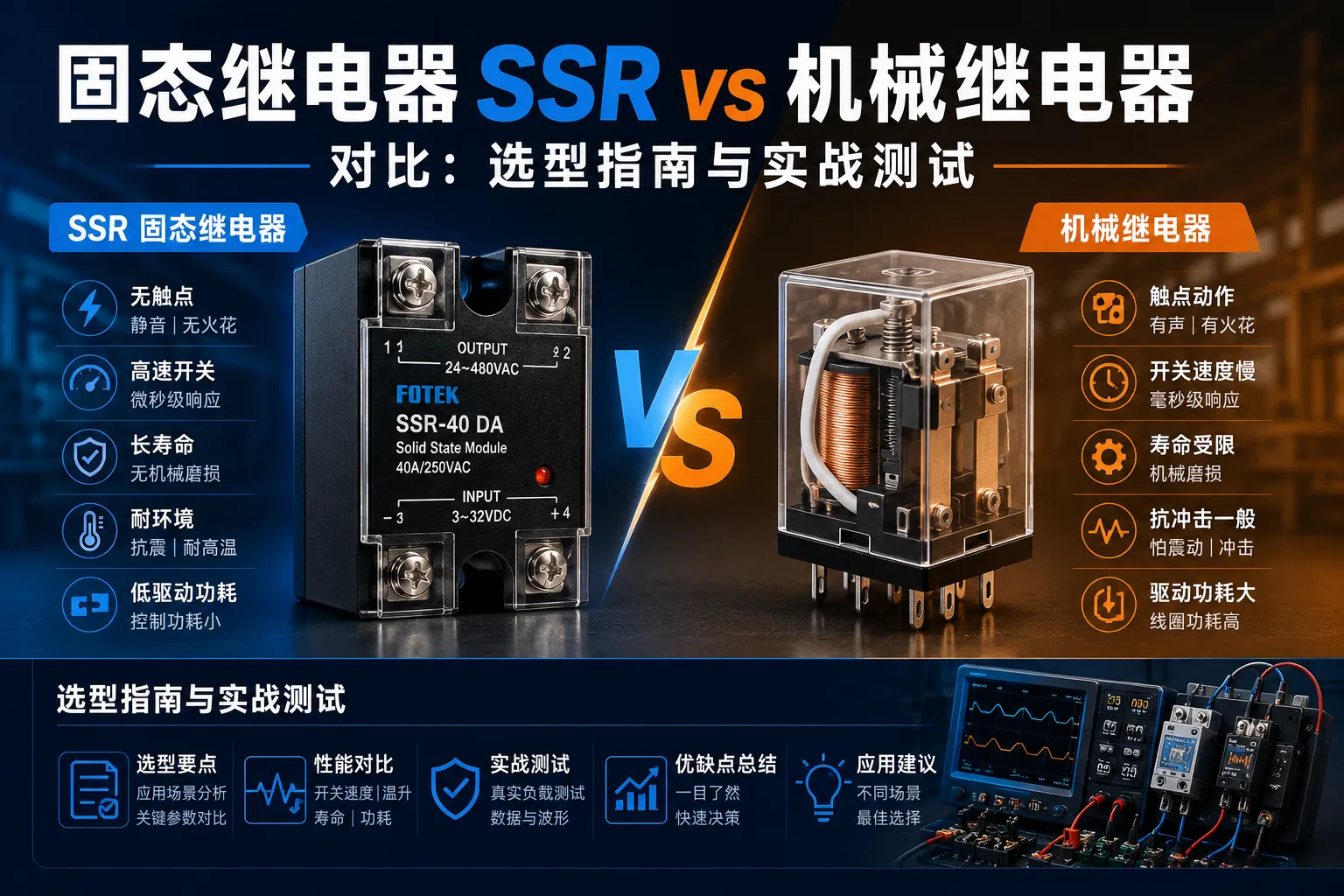
Today we’ll do a detailed comparison of solid state relays (SSR) and mechanical relays (EMR) to help you completely understand when to use which type.
Working Principle Comparison
Mechanical Relay (EMR)
The structure of mechanical relays is actually quite intuitive:
Coil energized → generates magnetic field → attracts armature → contacts close → circuit conductsCore components:
-
Coil: Generates magnetic field when energized
-
Armature: Metal piece attracted by the magnetic field
-
Contacts: Physical contact to conduct the circuit
-
Spring: Resets when power is off
Advantages: Physical contact isolation, extremely low on-resistance (typically <100mΩ)
Disadvantages: Mechanical wear, arc erosion, slow switching speed (10-50ms)
Solid State Relay (SSR)
Solid state relays are completely different, they use semiconductor devices to implement switching:
Input signal → optocoupler isolation → trigger circuit → triac/MOSFET conducts → circuit conductsCore components:
-
Optocoupler: Input/output electrical isolation
-
Trigger circuit: Controls semiconductor switching
-
Power device: Triac (AC) or MOSFET (DC)
Advantages: No mechanical wear, fast switching speed (<1ms), no sparks, silent
Disadvantages: Large voltage drop (1-2V), requires heat dissipation, may have leakage
Key Parameter Comparison Table
| Parameter | Mechanical Relay | Solid State Relay SSR |
|---|---|---|
| Switching lifespan | 100,000 - 1 million times | Unlimited (theoretically) |
| Switching speed | 10-50ms | 0.1-1ms |
| On-resistance | <100mΩ | Equivalent voltage drop 1-2V |
| Off-state leakage | Complete isolation | May have μA level leakage |
| Switching noise | Obvious “click” sound | Completely silent |
| Surge resistance | Strong (contacts withstand impact) | Weak (requires protection circuit) |
| Operating temperature | -40℃~+85℃ | -30℃~+100℃ |
| Price | Cheap (5-20 yuan) | More expensive (20-100 yuan) |
Practical Testing: Lifespan Comparison
I have two types of relays on hand:
-
Mechanical relay: Omron G5LE-14 DC12V (contact capacity 10A 250VAC)
-
Solid state relay: Fnirssi SSR-25DA (25A 24-380VAC)
Test Circuit
220V AC → Relay → 200W incandescent lamp load
Control signal: Arduino switches once per second
Test Results
Mechanical relay:
- After 10,000 cycles: Contacts slightly blackened, contact resistance increased from 50mΩ to 80mΩ
- After 50,000 cycles: Contacts obviously eroded, contact resistance 150mΩ, occasional poor contact
- After 80,000 cycles: Failed to disconnect after one switch (contacts welded)
Solid state relay:
-
After 100,000 cycles: No obvious performance change
-
After 200,000 cycles: Temperature rise slightly increased (from 35℃ to 45℃)
-
After 500,000 cycles: Still working normally
Conclusion: For scenarios requiring frequent switching (such as PID temperature control, PWM dimming), solid state relays have obvious advantages.
Switching Speed Test
Use oscilloscope to measure response time of both relays:
# Test code (Arduino)
void setup() {
  pinMode(RELAY_PIN, OUTPUT);
  pinMode(PROBE_PIN, INPUT);  // Connect to oscilloscope
}

void loop() {
  digitalWrite(RELAY_PIN, HIGH);
  delayMicroseconds(100);  // 100μs pulse
  digitalWrite(RELAY_PIN, LOW);
  delay(1000);
}
Actual test results:
-
Mechanical relay: Pull-in time 15ms, release time 8ms
-
Solid state relay: Turn-on time 0.5ms, turn-off time 0.3ms
Speed difference: over 30 times!
What does this mean? If you want to use relays for PWM dimming:
-
Mechanical relay: Maximum frequency about 10Hz (visible flicker to naked eye)
-
Solid state relay: Maximum frequency can reach 500Hz (completely flicker-free)
Noise Comparison
This is the most intuitive:
-
Mechanical relay: Every switch has a clear “click” sound, especially obvious in quiet environments. If it’s a high-power relay (like 40A or above), the sound is even louder.
-
Solid state relay: Completely silent, suitable for bedrooms, recording studios and other noise-sensitive scenarios.
Heat Generation and Dissipation
This is the biggest pain point of solid state relays.
Heat Generation Principle
When solid state relays conduct, they have a 1-2V voltage drop. According to the formula P = V × I:
When load current is 10A: P = 1.5V × 10A = 15W
When load current is 20A: P = 1.5V × 20A = 30W
15-30W of heat generation is equivalent to a small soldering iron! Without a heatsink, the SSR will overheat and protect or damage within a few minutes.
Heat Dissipation Recommendations
| Load Current | Heat Dissipation Solution |
|---|---|
| <5A | Small aluminum heatsink (20×20mm) |
| 5-10A | Medium heatsink (40×40mm) + thermal grease |
| 10-20A | Large heatsink (60×60mm) + forced air cooling |
| >20A | Heatsink + fan + temperature monitoring |
Mechanical relays hardly generate any heat (small contact resistance), which is one of their advantages.
Leakage Problem
Solid state relays may have microamp-level leakage current when off, which is fatal for some loads:
Affected loads:
-
LED lights: Slightly glow after being turned off (ghost effect)
-
Low-power devices: Cannot be completely powered off
-
Sensitive circuits: May trigger falsely
Solutions:
-
Parallel bleed resistor (100kΩ-1MΩ)
-
Choose SSR with zero-crossing detection (reduces leakage)
-
Switch to mechanical relay
Selection Decision Tree
Need frequent switching (>1 time/minute)?
├─ Yes → Solid state relay SSR
└─ No → Continue judgment

Need complete isolation (zero leakage)?
├─ Yes → Mechanical relay
└─ No → Continue judgment

Noise sensitive?
├─ Yes → Solid state relay SSR
└─ No → Continue judgment

Load has surge current (motors, transformers)?
├─ Yes → Mechanical relay (or SSR + protection circuit)
└─ No → Continue judgment

Limited budget?
├─ Yes → Mechanical relay
└─ No → Solid state relay SSR
Typical Application Scenarios
Solid State Relay SSR is more suitable for:
-
PID temperature control systems: Need to switch multiple times per second for precise temperature control, mechanical relays can’t handle it at all
-
PWM dimming systems: Commercial lighting, stage lighting need high-frequency flicker-free dimming, only SSR can achieve this
-
Silent environment applications: Hospital wards, recording studios, bedrooms and other noise-sensitive places
-
Vibration environments: Vehicle equipment, industrial vibration environments, SSR has no mechanical parts and is not afraid of vibration
-
High reliability scenarios: Applications requiring millions of switching cycles, such as automated production lines, test equipment
Mechanical relays are more suitable for:
-
High-power motor control: Withstands surge impact
-
Complete power-off requirements: Zero leakage
-
Low-cost projects: Budget sensitive
-
Occasional switching: Such as lighting control a few times a day
-
Multi-channel switching: Multiplexers, signal switching
Hardware List and Prices
| Model | Type | Specifications | Unit Price | Application Scenario |
|---|---|---|---|---|
| Omron G5LE-14 | Mechanical | 10A 250VAC | ¥8 | General control |
| Panasonic AQH212 | Mechanical | 5A 250VAC | ¥12 | Low power |
| Fnirssi SSR-25DA | Solid state | 25A 24-380VAC | ¥35 | Heating control |
| Schneider RM1B | Solid state | 40A 24-480VAC | ¥85 | Industrial motors |
| Chint JQX-13F | Mechanical | 10A 250VAC | ¥5 | Low cost |
Purchase suggestions:
-
Taobao/1688 prices are cheaper (about 60-70% of above prices)
-
Industrial applications recommend choosing branded products (Omron, Schneider, Panasonic)
-
DIY projects can use domestic relays (Chint, Delixi)
Common Problem Troubleshooting
Q1: What to do if solid state relay overheats?
Checklist:
-
Is heatsink properly installed?
-
Is thermal grease applied evenly?
-
Does load current exceed rated value? (Recommend leaving 30% margin)
-
Is forced air cooling with fan needed?
Rule of thumb: Case temperature should not exceed 80℃, improve heat dissipation if it does.
Q2: What to do if mechanical relay contacts stick?
Causes:
-
Load current too large
-
Inductive load (motors, transformers) generates back EMF
-
Switching frequency too high
Solutions:
-
Choose relay with larger capacity
-
Parallel RC snubber circuit (0.1μF + 100Ω)
-
Switch to solid state relay
Q3: LED lights slightly glow after being turned off?
Cause: Solid state relay leakage current
Solutions:
-
Load parallel 100kΩ resistor
-
Switch to mechanical relay
-
Choose low-leakage SSR model
Q4: Relay switching interferes with other circuits?
Cause: Arc or voltage spike
Solutions:
-
Relay coil parallel flyback diode
-
Add filter capacitor to power supply
-
Add shielding to sensitive circuits
Summary
| Scenario | Recommended Type | Reason |
|---|---|---|
| High-frequency switching (PID temperature control) | SSR | Long lifespan, fast speed |
| High-power motors | Mechanical | Surge resistant, low cost |
| Silent requirements | SSR | No noise |
| Complete power-off | Mechanical | Zero leakage |
| Limited budget | Mechanical | Cheap price |
| Vibration environment | SSR | No mechanical parts |
Core recommendations:
-
Don’t use mechanical relays for high-frequency switching scenarios to save money (short lifespan)
-
Don’t use SSR in scenarios requiring complete power-off (has leakage)
-
SSR must be equipped with heatsink (otherwise will overheat and damage)
-
Add protection circuits for inductive loads (extend lifespan)
Choosing the right relay type can make your project more reliable and durable. Hope this comparison helps you make the right choice!
Hope this blog post is helpful to you!